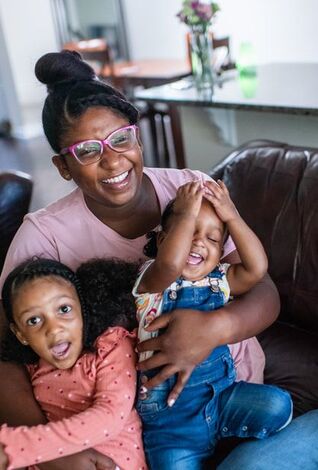
This week's guest blogger is Saidah Pearson, RN and IBCLC. She is the owner of Four Sisters Hands, a lactation support practice in the Triangle area. Learn more about Saidah's business and her much needed work with women and moms in the interview below.
1. Tell me about yourself.
I am a St. Louis native and have been in NC for five years. I am a wife and mom to four sweet little ladies! I come from a large family and am the only girl out of four kids. I am a major introvert but my children and husband force me to be an extrovert because they all have never met a stranger. I enjoy talking about all things mommy, babies, and boobs! Oh and I will forever be a reality tv girl. I can’t help myself!
2. How/why did you become an RN and IBCLC?
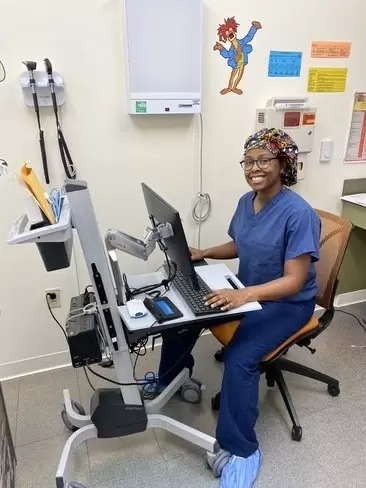
I have wanted to be a NICU nurse since I was 9 years old after seeing a family friend have a baby prematurely. After graduating from undergrad with a degree in Biology I went back to nursing school. I originally went to school to become a Biomedical Engineer and wanted to pursue medical research. I like to say that I took the long walk home and it gave me a better perspective when becoming a nurse. I have been a nurse for five years and spent three of those years bedside in two different Level IV NICUs in the triangle. I always knew that my end goal was to be a lactation consultant and serve medically complex families. I attended the Mary Rose Tully Training Initiative at UNC Chapel Hill to get my lactation training. I one day hope to go back to the NICU as an LC but for now I am enjoying serving the community outside of the hospital.
3. What is the mission or main focus of Four Sisters' Hands?
The mission of Four Sisters’ Hands is to truly meet families where they are and provide individualized support to help them meet their lactation goals. I have a somewhat unique approach that is rooted in focusing on the family’s goals while also presenting evidence based facts that allows them to make informed decisions. The major pillar of my work is to increase visibility and support for Black and brown families. When I was nursing my first child I did not have any physical support that looked like me or had a cultural understanding of where I was. Representation is everything and I work very hard to give support to all families but work extra hard to give support to families that look like mine.
4. What are the best & most challenging parts of being a business owner and health practitioner?
The best and worst part of being a business owner is the flexibility. I appreciate that as a stay at home mom I can truly tailor my business to the needs of my family. In the same sense there is no one to do the work but me which can be A LOT! The actual running of a business I could pass on and just do the actual work of supporting families but such is life. The best part of “the work” is helping families reach their goals. Seeing them trust themselves. Teaching the whole family about lactation. Holding space and the gift of being able to support people in their most vulnerable time of life. Oh my most absolute favorite thing is the baby snuggles!! The hardest part of “the work” is the second guessing of myself as new IBCLC. Sometimes not feeling like I know enough or have enough to give. Combating my client’s self doubt that is sometimes imposed by those closest to them.
5. Where do you see yourself and your business in 5 years?
In five years I would love to be a mentor and teacher. I want to be able to provide education for not only families but for other health providers that are in a position to support families. I also want to pour into other Black future IBCLCs because the path there is lonely and hard sometimes. Working specifically with the HBCUs in NC that are training future IBCLCs. I want to work with more NICU families on a consistent basis and help them reach their goals. I would love to have a breastfeeding clinic that could provide community support and serve as a gathering space. A place where love and care oozes out the walls and flows into the streets!
6. Who do you look up to or admire in the health community?
Janiya Williams is who I call my lactation fairy godmother in my head! She gave a presentation to our class in my lactation program and I was in awe! Not only does she positively impact her community through lactation and her support of doulas but she is also a wife and mom. She is highly respected and that doesn’t happen without being at the top of your game. She is a beacon of hope for myself that the vision that I have is not only possible but can far exceed what I think. She is what it means to provide representation to Black IBCLCs and I am grateful to know her.
7. Tell me about your most recent business win.
My most recent win was actually recommitting myself to my practice. I have had a hard time deciding how much to give to my practice while also being a stay at home mom. Going from working in the hospital as a nurse with a team to being a one woman show has been such an adjustment for me. After some really hard conversations with myself, my husband, and lots of time spent with God, I realized that this is my life’s work and I am equipped with the things I need to make it happen. Even if I don’t know the how, I will keep one foot in front of the other and things will fall in place. If I am going to bet on anything I want it to be myself!
8. Please share any upcoming events or programs you will be participating in or any special offerings for new clients?
I will be hosting my first virtual breastfeeding support group on May 17th! I am really excited because this is something I’ve wanted to do but wasn’t sure if I could. I hope to start in person meetings this fall. I am also planning to roll out prenatal breastfeeding education classes in the fall. One of my passions in lactation is prenatal breastfeeding education so I am looking forward to providing more ways for families to get support before their baby comes!
I am a St. Louis native and have been in NC for five years. I am a wife and mom to four sweet little ladies! I come from a large family and am the only girl out of four kids. I am a major introvert but my children and husband force me to be an extrovert because they all have never met a stranger. I enjoy talking about all things mommy, babies, and boobs! Oh and I will forever be a reality tv girl. I can’t help myself!
2. How/why did you become an RN and IBCLC?
I have wanted to be a NICU nurse since I was 9 years old after seeing a family friend have a baby prematurely. After graduating from undergrad with a degree in Biology I went back to nursing school. I originally went to school to become a Biomedical Engineer and wanted to pursue medical research. I like to say that I took the long walk home and it gave me a better perspective when becoming a nurse. I have been a nurse for five years and spent three of those years bedside in two different Level IV NICUs in the triangle. I always knew that my end goal was to be a lactation consultant and serve medically complex families. I attended the Mary Rose Tully Training Initiative at UNC Chapel Hill to get my lactation training. I one day hope to go back to the NICU as an LC but for now I am enjoying serving the community outside of the hospital.
3. What is the mission or main focus of Four Sisters' Hands?
The mission of Four Sisters’ Hands is to truly meet families where they are and provide individualized support to help them meet their lactation goals. I have a somewhat unique approach that is rooted in focusing on the family’s goals while also presenting evidence based facts that allows them to make informed decisions. The major pillar of my work is to increase visibility and support for Black and brown families. When I was nursing my first child I did not have any physical support that looked like me or had a cultural understanding of where I was. Representation is everything and I work very hard to give support to all families but work extra hard to give support to families that look like mine.
4. What are the best & most challenging parts of being a business owner and health practitioner?
The best and worst part of being a business owner is the flexibility. I appreciate that as a stay at home mom I can truly tailor my business to the needs of my family. In the same sense there is no one to do the work but me which can be A LOT! The actual running of a business I could pass on and just do the actual work of supporting families but such is life. The best part of “the work” is helping families reach their goals. Seeing them trust themselves. Teaching the whole family about lactation. Holding space and the gift of being able to support people in their most vulnerable time of life. Oh my most absolute favorite thing is the baby snuggles!! The hardest part of “the work” is the second guessing of myself as new IBCLC. Sometimes not feeling like I know enough or have enough to give. Combating my client’s self doubt that is sometimes imposed by those closest to them.
5. Where do you see yourself and your business in 5 years?
In five years I would love to be a mentor and teacher. I want to be able to provide education for not only families but for other health providers that are in a position to support families. I also want to pour into other Black future IBCLCs because the path there is lonely and hard sometimes. Working specifically with the HBCUs in NC that are training future IBCLCs. I want to work with more NICU families on a consistent basis and help them reach their goals. I would love to have a breastfeeding clinic that could provide community support and serve as a gathering space. A place where love and care oozes out the walls and flows into the streets!
6. Who do you look up to or admire in the health community?
Janiya Williams is who I call my lactation fairy godmother in my head! She gave a presentation to our class in my lactation program and I was in awe! Not only does she positively impact her community through lactation and her support of doulas but she is also a wife and mom. She is highly respected and that doesn’t happen without being at the top of your game. She is a beacon of hope for myself that the vision that I have is not only possible but can far exceed what I think. She is what it means to provide representation to Black IBCLCs and I am grateful to know her.
7. Tell me about your most recent business win.
My most recent win was actually recommitting myself to my practice. I have had a hard time deciding how much to give to my practice while also being a stay at home mom. Going from working in the hospital as a nurse with a team to being a one woman show has been such an adjustment for me. After some really hard conversations with myself, my husband, and lots of time spent with God, I realized that this is my life’s work and I am equipped with the things I need to make it happen. Even if I don’t know the how, I will keep one foot in front of the other and things will fall in place. If I am going to bet on anything I want it to be myself!
8. Please share any upcoming events or programs you will be participating in or any special offerings for new clients?
I will be hosting my first virtual breastfeeding support group on May 17th! I am really excited because this is something I’ve wanted to do but wasn’t sure if I could. I hope to start in person meetings this fall. I am also planning to roll out prenatal breastfeeding education classes in the fall. One of my passions in lactation is prenatal breastfeeding education so I am looking forward to providing more ways for families to get support before their baby comes!
I’m Saidah RN, IBCLC. A wife and mom of four young girls based in Cary, NC. I provide in-home and virtual lactation support to families from pregnancy to weaning! I have been a nurse for five years and recently left the NICU bedside to support families in the community as an IBCLC. I love all things baby snuggles and lactation. I truly think that individualized lactation support is the key to help you reach your goals. This to me means meeting families exactly where they are, providing the information, and supporting families to make informed decisions. You can learn more about me by visiting my website and follow me on Facebook and Instagram @foursistershands.
 RSS Feed